

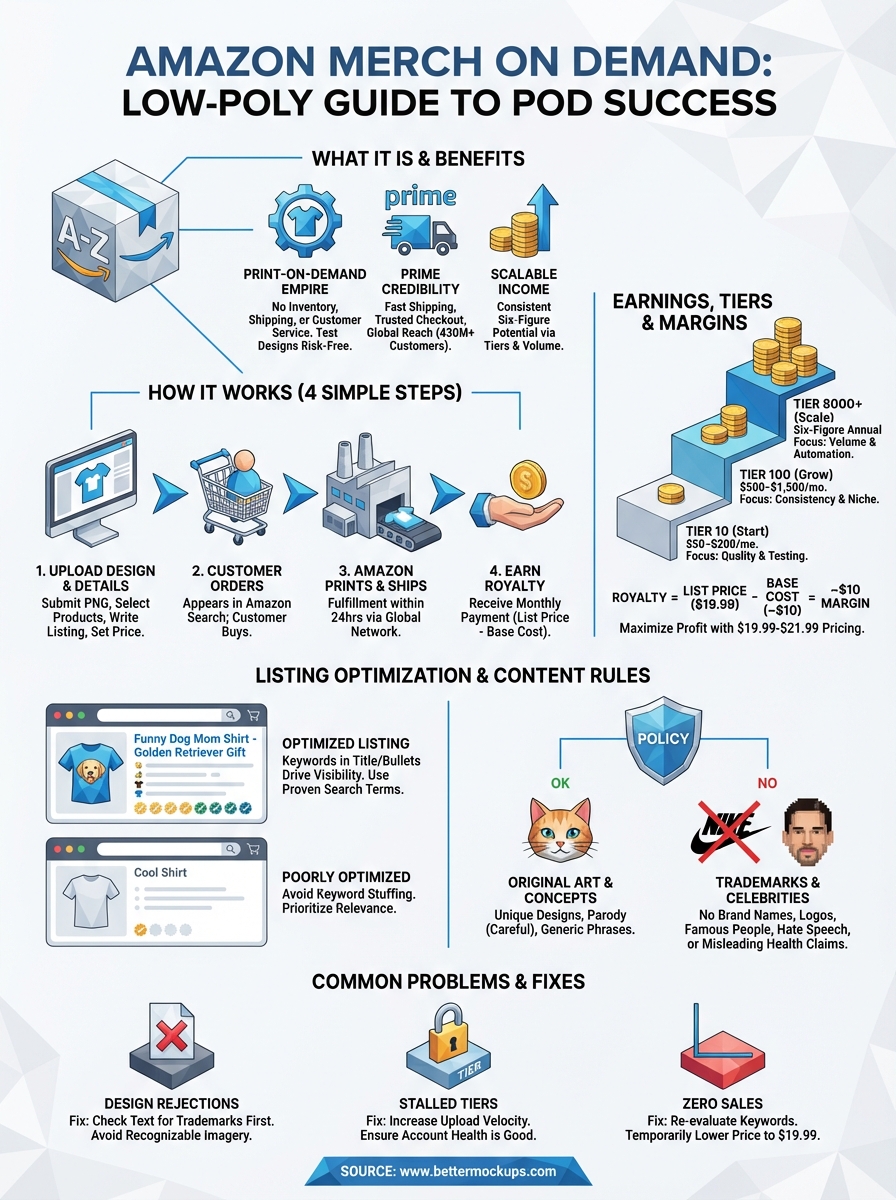
Amazon built a print-on-demand empire that most sellers still underestimate. Amazon Merch on Demand lets creators upload designs, pick products, and earn royalties on every sale, without touching inventory, shipping labels, or customer service tickets. It's the entry point thousands of designers use to test whether their art actually sells, and for established creators, it becomes a consistent six-figure revenue stream.
But here's what the program overviews don't mention: success on Merch depends on more than clever designs. It depends on understanding tier systems, niche research, and how your products actually appear in listings. The gap between what customers see and what they receive is where reviews turn negative and momentum stalls. That's a lesson POD sellers learn across every platform, whether selling apparel on Amazon or phone cases on Etsy. At Bettermockups, we've built our entire business around closing that gap, because accurate product representation isn't optional when your reviews determine your visibility.
This guide covers how Amazon Merch on Demand actually works in 2026, what you can realistically earn at each tier, and the strategies that separate sellers who plateau at 100 designs from sellers who scale past 10,000. Whether you're submitting your first application or looking to expand your POD business into new product categories, you'll find the specifics that actually matter, not the recycled advice that stopped working three algorithm updates ago.
Why Amazon Merch on Demand matters
Most print-on-demand platforms force you to split focus between designing products and managing a storefront. Amazon Merch on Demand eliminates the storefront problem entirely by placing your designs directly inside the world's largest retail ecosystem, where 430 million active customers already search, browse, and buy without needing to discover your independent shop first. Your products appear in organic search results alongside established brands, which means you compete on design quality and listing optimization, not on building traffic from zero.
The financial model removes every barrier that traditionally prevents creators from launching physical products. You pay nothing to join, nothing to upload designs, and nothing when products don't sell. Amazon handles printing, fulfillment, customer service, and returns. Your only investment is the time required to create designs and optimize listings. If a design fails, you delete it and try something else. There's no inventory writeoff, no storage fees, and no sunk cost beyond the hours you chose to spend. That's why thousands of designers use Merch as their testing ground before committing to inventory-based models or premium POD partnerships.
The ability to test 100 design concepts without financial risk creates a feedback loop that traditional product businesses can't replicate.
Revenue potential scales directly with your tier level and upload consistency. Sellers who treat Merch like a portfolio business, uploading daily and iterating based on what sells, regularly build four-figure monthly royalty streams within their first year. Six-figure annual earners exist across multiple niches, from niche hobbies to seasonal trends. The difference between hobbyist income and professional income isn't talent or design complexity. It's volume, niche selection, and the discipline to keep uploading when early designs don't convert. Amazon rewards consistency with higher tiers, which unlock more upload slots, which compound into more products in front of more searches.
Access to customer trust you didn't build
Launching a Shopify store means convincing strangers to trust a brand they've never heard of with their credit card information. Amazon Merch products inherit Amazon's credibility automatically, which collapses the trust barrier that kills most new ecommerce businesses before their first sale. Customers see your design on a product page that looks identical to any other Amazon listing, complete with Prime shipping, familiar checkout flows, and buyer protection guarantees they already rely on. You don't need to build that trust. You borrow it.
Platform credibility extends beyond checkout psychology. Amazon's fulfillment network ensures delivery speed and reliability that independent sellers can't match without significant infrastructure investment. When a customer orders your design on a Tuesday, it ships Wednesday and arrives by Friday. That expectation is baked into the Amazon experience, and your products benefit from it without requiring you to negotiate with printing facilities, manage inventory buffers, or coordinate logistics. The operational advantages that take years to build as an independent seller come standard with every Merch listing.
Portfolio diversification without operational complexity
Most successful POD sellers operate across multiple platforms because single-platform dependency is a business risk you can't afford once revenue matters. Amazon Merch functions as a portfolio hedge, generating income independently from Etsy shop performance, Shopify traffic fluctuations, or TikTok algorithm changes. You upload designs once and let Amazon's search traffic work for you, which means your time investment per product decreases as your catalog grows. A 500-design portfolio continues generating royalties months or years after upload, without requiring ongoing promotional effort.
Diversification also creates competitive intelligence you can't buy. When a design performs well on Merch, you know it has real market demand, not just algorithmic favor on a single platform. That validated concept becomes a candidate for expansion into higher-margin POD products like phone cases, where accurate mockups matter more because customer expectations are stricter. Sellers who use Merch as a proving ground before investing in specialized product photography reduce the risk of launching designs that looked good in theory but don't convert in practice.
Testing market demand before committing resources
Design validation is expensive when every test requires sample orders, photography, and storefront setup. Amazon Merch turns validation into a near-zero-cost operation where you upload a design, set a price, and let organic traffic determine whether customers care. A design that generates 50 sales in its first month signals real demand. A design that generates zero impressions after two weeks tells you the keyword strategy failed or the niche is oversaturated. Either way, you learn without financial loss.
This testing advantage matters most when you're deciding which niches deserve deeper investment. A seller considering a specialized phone case line for a specific fandom can test demand by uploading related apparel designs to Merch first. If those designs convert, the niche is validated. If they don't, you saved yourself from ordering 200 phone cases that would sit in inventory while you scramble to find buyers. The feedback loop speeds up decision-making and eliminates guesswork from product strategy.
How Amazon Merch on Demand works
The operational model is simpler than most POD platforms because Amazon strips away every step that doesn't involve creating designs. You upload artwork, select products, write listing details, and set prices. Amazon prints each item only after a customer orders it, ships it through their fulfillment network, and deposits your royalty into your account. There's no inventory to manage, no supplier relationships to maintain, and no shipping logistics to coordinate. Your role begins and ends with the creative and strategic decisions that determine whether your products appear in relevant searches and convert browsers into buyers.
The upload and product creation process
When you log into your Merch dashboard, you start by selecting a product type, typically a t-shirt for new sellers since it's the default offering. You upload your design file as a PNG with transparent background, position it on the product template Amazon provides, and preview how it renders on different garment colors. The system requires specific file dimensions and resolution standards, which vary by product. A standard t-shirt design uses 4500 x 5400 pixels at 300 DPI, ensuring print quality meets Amazon's production standards without pixelation or color distortion.
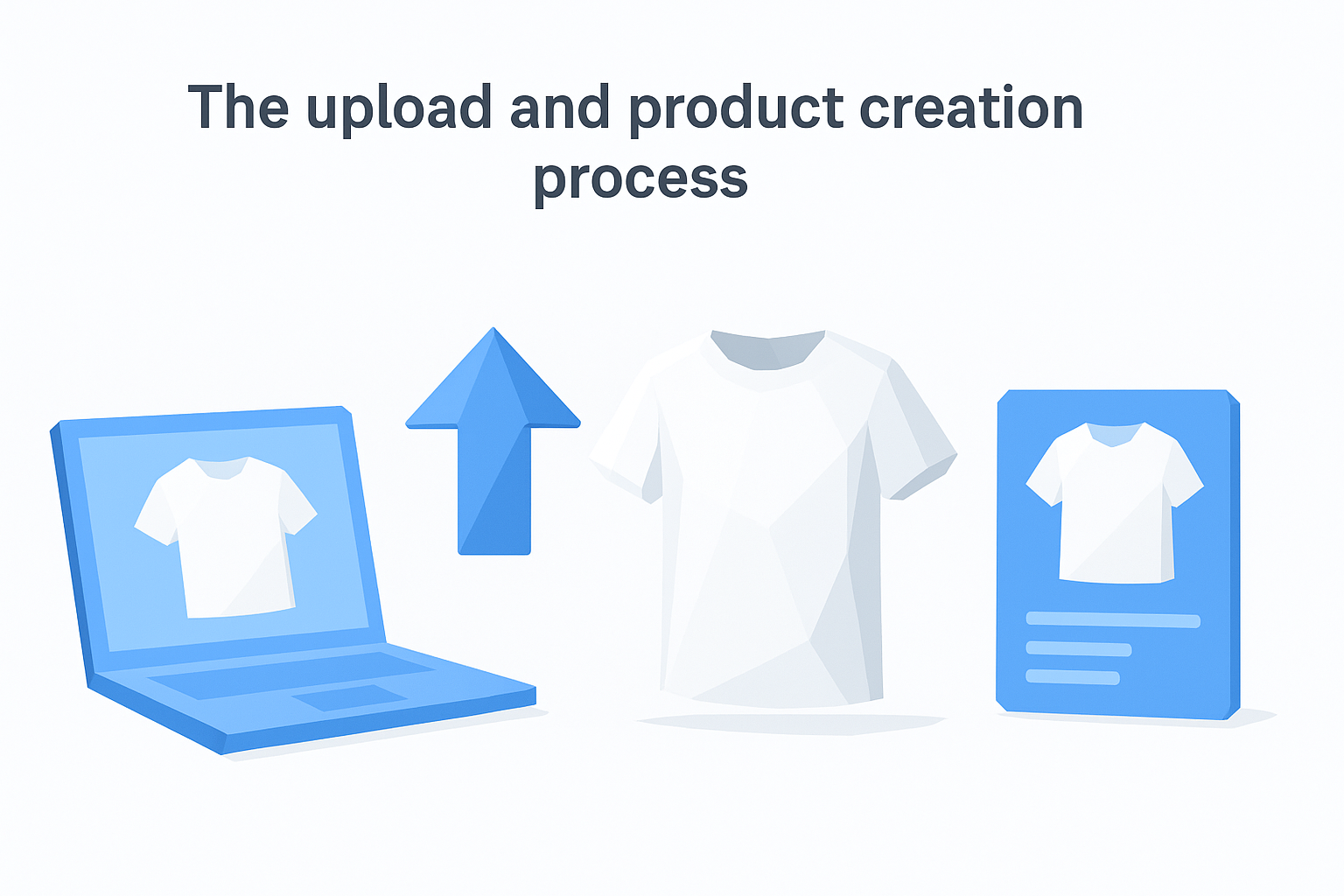
After uploading your artwork, you choose which product colors will carry your design. Each color variation becomes a separate customer-facing option within the same listing, so a design offered on black, navy, and white shirts gives buyers three choices without requiring you to create three separate products. You then write the product title, brand name, bullet points, and description. These fields determine search visibility, not just customer perception, which means keyword strategy matters as much as design quality when you're competing against thousands of similar products.
Amazon handles production and fulfillment
Once you publish a listing, it enters Amazon's catalog and appears in search results based on your keyword choices and listing optimization. When a customer clicks "Add to Cart" and completes checkout, Amazon automatically routes the order to their printing facility. The system selects the production location closest to the customer's shipping address, prints the design onto the product, and initiates fulfillment within 24 hours. You receive no notification about individual orders unless there's a content policy issue or customer inquiry that requires your attention.
Amazon's fulfillment infrastructure handles an average of 7.5 billion packages annually, which means your products move through the same logistics network that powers Prime delivery for every other item on the platform.
Shipping speed matches standard Amazon timelines, typically 3-5 business days for domestic orders. Prime-eligible products ship faster, though not all Merch items qualify for Prime depending on production location and customer address. Returns follow Amazon's standard policy, which allows customers to initiate returns within 30 days. Amazon processes the return and adjusts your royalty balance automatically, deducting the previously paid amount from your next payment cycle.
How you earn royalties on each sale
Your royalty is the difference between the list price you set and Amazon's base production cost. If you price a shirt at $19.99 and Amazon's base cost is $10.15, you earn $9.84 per sale. Amazon merch on demand displays the base cost during pricing setup, so you always know your margin before publishing. Payment occurs monthly through direct deposit or check, with a 30-day delay to account for potential returns and chargebacks.
Eligibility, application, and account setup
Getting into Amazon Merch on Demand requires approval, not just registration, which means you submit an application and wait for Amazon to evaluate whether you qualify. The process isn't instant, acceptance isn't guaranteed, and rejection doesn't always come with an explanation that helps you improve your next attempt. Most applicants who focus on demonstrating design capability and professional intent get approved within 2-6 weeks, though some wait months while others never receive responses. Understanding what Amazon looks for during evaluation increases your approval odds significantly.
Who qualifies and who doesn't
Amazon accepts applicants from most countries, though geographic restrictions exist for regions where Amazon doesn't operate printing facilities or fulfill orders. United States, United Kingdom, Germany, France, Italy, and Spain represent the primary eligible markets, with occasional expansions into additional territories. You need a valid tax identification number for your country of residence, either a Social Security Number or Employer Identification Number for US applicants, or equivalent documentation for international sellers.
Professional background matters less than you'd expect. Amazon doesn't require previous ecommerce experience, design credentials, or established online portfolios. What they do require is evidence that you understand intellectual property basics and won't upload copyrighted or trademarked content that creates legal liability. Your application should demonstrate you're submitting as a legitimate creator, not someone planning to copy existing brands or violate content policies for quick profit.
The application process explained
You start at merch.amazon.com and click the application button, which directs you to a form requesting basic information about yourself, your design experience, and your intent for using the platform. The questions aren't complex, but your answers determine whether a reviewer sees you as qualified. Describe your design background honestly, whether that means professional graphic design work, hobbyist illustration, or digital art creation. Amazon values clarity over credentials.
The portfolio requirement causes the most application anxiety, though it shouldn't. You upload 3-5 design samples that demonstrate your capability, not your entire body of work. These samples don't need to be print-ready t-shirt designs. Original illustrations, digital artwork, or graphic compositions that show creative skill satisfy the requirement. Avoid submitting designs that incorporate recognizable brands, celebrity likenesses, or content that could trigger trademark concerns.
Applications that clearly communicate creative intent and respect for intellectual property guidelines convert to approvals at significantly higher rates than applications focused solely on earning potential.
Processing times vary without predictable patterns. Some applicants receive approval emails within one week, while others wait two months before hearing anything. Amazon provides no status updates during review, which means checking your email becomes a daily ritual until the decision arrives.
What happens after approval
Approval emails include your login credentials and instructions for accessing your Merch dashboard. You start at Tier 10, which limits you to 10 live designs at any time. This constraint forces new sellers to focus on quality over quantity, testing concepts deliberately rather than flooding the catalog with untested ideas. Every time you reach your tier's sales threshold, Amazon automatically promotes you to the next tier, which unlocks additional upload slots and expands your earning potential.
Your first task involves completing tax documentation through Amazon's system, which determines how royalties are reported and whether withholding applies to your payments. US sellers complete a W-9 form, while international sellers submit W-8BEN documentation. Payment setup follows, where you add bank account details for direct deposit or select check delivery if you prefer physical payments.
Products you can sell and what sells well
Amazon started Merch with t-shirts and spent years expanding into categories that actually convert for POD sellers. You can now sell across multiple product types, though not every category performs equally and your tier level determines which products you can access immediately. Standard t-shirts remain the foundation because they convert reliably, cost less to produce, and give you the fastest path to tier advancement. Once you prove consistent sales, Amazon unlocks premium apparel, accessories, and home goods that carry higher royalty potential but require more sophisticated design strategies to succeed.
Available product categories
Your product selection expands as you move through tiers, but tier 10 sellers start with standard t-shirts only. Once you reach tier 25, Amazon unlocks premium t-shirts, long sleeve shirts, and sweatshirts. Tank tops, hoodies, and PopSockets become available at tier 100, followed by phone cases and tote bags at tier 500. The highest tiers grant access to throw pillows, phone cases for additional models, and zip hoodies. This staged unlock system prevents new sellers from spreading effort across too many product types before understanding what actually sells in their niche.
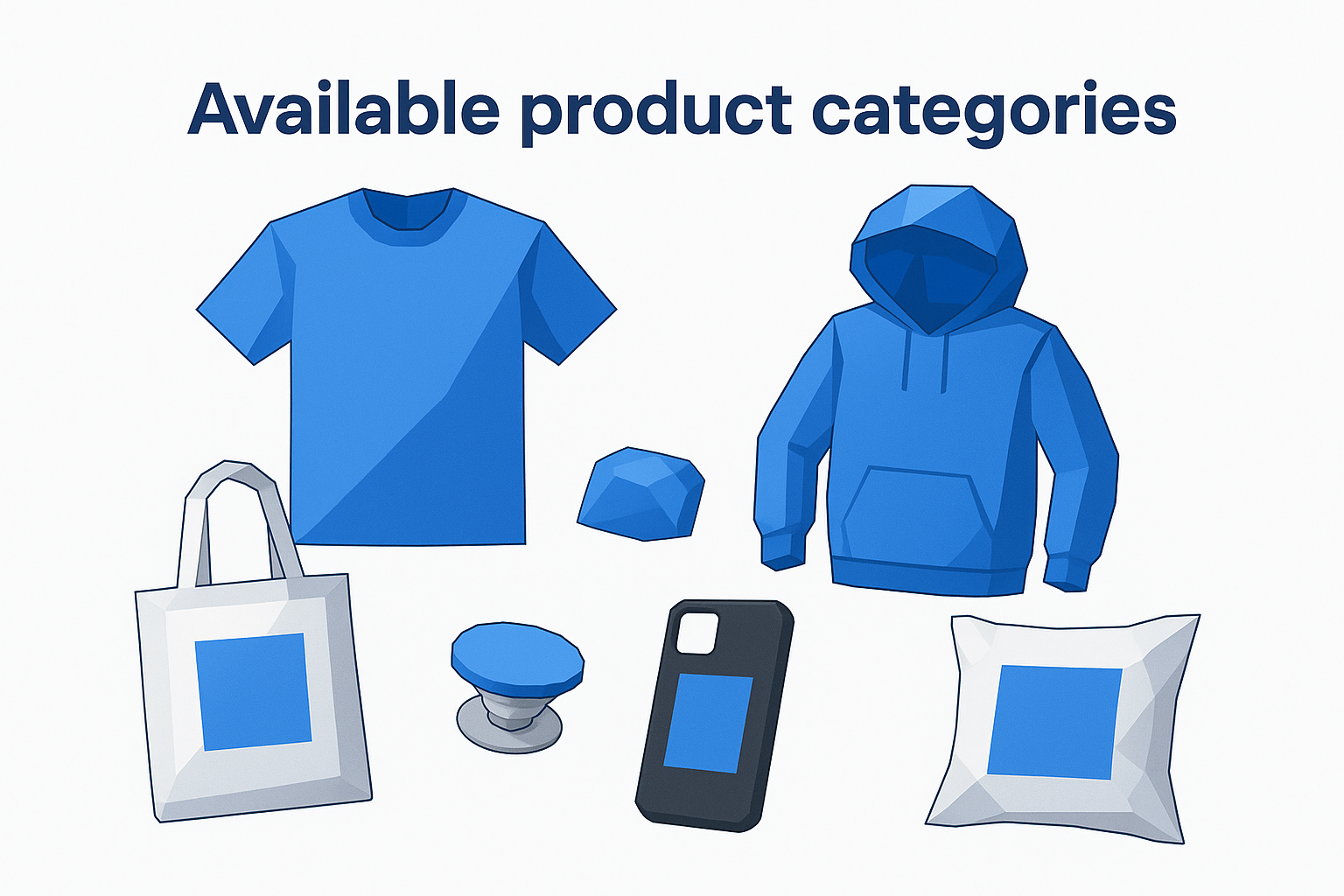
Standard t-shirts dominate sales volume because they're impulse-friendly at $19.99-$24.99 price points and carry broad appeal across demographics. Hoodies and sweatshirts generate higher royalties per sale but move slower due to price sensitivity and seasonal demand patterns. Phone cases represent a growing category, though sellers transitioning from apparel often underestimate how much design accuracy matters when customers expect their case to fit perfectly. PopSockets appeal to younger demographics and work well for fandoms, but the small print area limits design complexity.
Which niches consistently perform
Hobby-specific designs outsell generic motivational quotes because customers searching for niche interests convert at higher rates than browsers looking at broad lifestyle categories. Fishing enthusiasts buy fishing-themed shirts. Dog owners buy breed-specific apparel. Occupation-based designs targeting nurses, teachers, and tradespeople generate reliable sales because professional identity creates emotional purchase motivation that transcends price sensitivity.
Products that solve identity expression needs convert 3-4x better than products that simply look aesthetically pleasing, because buyers see them as personal statements rather than disposable fashion.
Seasonal niches spike hard during specific months then disappear completely. Christmas designs sell from October through mid-December, then stop converting until the following year. Birthday month designs perform year-round with predictable volume spikes. Sports team seasons create temporary demand windows that reward sellers who upload before playoffs begin and accept that inventory becomes dead weight once championships conclude.
Seasonal vs evergreen products
Evergreen designs generate consistent monthly income without requiring constant attention or replacement. Pet owner designs, sarcastic humor targeting specific demographics, and minimalist text-based concepts maintain steady search volume year-round. You upload them once and collect royalties indefinitely, which makes them the foundation of sustainable Merch income. The tradeoff is lower peak performance compared to seasonal hits that can generate hundreds of sales during their active window.
Seasonal products require timing precision that most new sellers underestimate. You need designs live 6-8 weeks before peak demand because Amazon's search algorithm favors listings with established performance history. Veterans who upload Halloween designs in late August consistently outsell sellers who wait until October. The mistake is treating amazon merch on demand like a last-minute opportunity when algorithmic visibility rewards sellers who plan product launches around the calendar, not around inspiration.
Royalties, pricing, and earning potential
Amazon's royalty structure is transparent but unforgiving. You earn the difference between your list price and Amazon's base cost, which varies by product type and color. Standard t-shirts carry a base cost between $9.69 and $10.68 depending on garment color, which means a $19.99 shirt generates roughly $9.31 to $10.30 in royalties per sale. Premium products like hoodies cost more to produce, typically $16-$18, but allow higher list prices that maintain similar percentage margins while increasing absolute dollar returns.
How royalty calculations actually work
Amazon displays the exact base cost during price setup, so you always know your margin before publishing a listing. Dark-colored garments cost slightly more to produce than light colors because they require additional ink layers for print quality. A black t-shirt might carry a $10.68 base cost while white costs $9.69, creating a 99-cent margin difference that compounds across hundreds of sales. Most sellers standardize pricing across colors to simplify listing management, accepting slightly lower margins on dark garments in exchange for operational simplicity.
Payment timing follows a predictable monthly schedule with built-in delays to account for returns. Amazon pays approximately 30 days after the month your sales occur, meaning February sales arrive in late March. Your dashboard displays pending royalties separately from confirmed payments until the return window closes and amounts become final. International sellers face additional withholding if tax treaties don't exist between their country and the United States, which reduces net royalties by 30% unless proper documentation eliminates the withholding requirement.
Pricing strategies that maximize profit without killing conversion
Competitive pricing matters more than premium positioning for most amazon merch on demand sellers. Products priced at $19.99-$21.99 convert reliably across multiple niches because they fall below the psychological threshold where buyers start comparison shopping intensively. Every dollar you add above $22.99 cuts conversion rates by 15-25% unless your design targets collectors or superfans who prioritize exclusivity over price.
Sellers who test identical designs at different price points consistently find that $19.99 listings generate 40% more sales than $24.99 listings, more than offsetting the lower per-unit royalty.
Higher-margin products justify premium pricing when design complexity or niche specificity creates competitive moats. A generic motivational quote rarely justifies $24.99, but a hyper-specific design targeting vintage car enthusiasts can command $26.99 because alternatives don't exist. The key is understanding whether you're competing on broad appeal or solving a specific identity expression need that commands pricing power.
Realistic income expectations by tier
Tier 10 sellers who upload quality designs and optimize listings typically earn $50-$200 in their first month once products gain search visibility. Reaching tier 100 unlocks enough upload slots to generate $500-$1,500 monthly if you maintain consistent upload velocity and diversify across proven niches. Six-figure annual earners operate at tier 8,000 or higher, managing catalogs with thousands of active designs that compound into substantial passive income streams. The difference between tiers isn't just upload limits, it's the compounding effect of having more products visible in more searches, which turns single sales into predictable revenue patterns.

Design and content rules to avoid takedowns
Amazon's content policy functions as both quality filter and legal shield, protecting the platform from intellectual property lawsuits while maintaining product catalog integrity. Violating these rules doesn't just get your design rejected, it threatens your entire account status because repeated policy violations trigger permanent bans that erase your tier progress and terminate future earning potential. Understanding where the boundaries exist matters more than creative freedom because one trademarked phrase in a listing title can invalidate months of work building your catalog.
The enforcement system combines automated scanning with human review, which means some violations get caught immediately during upload while others slip through only to trigger takedown notices weeks after publication. Automated systems flag obvious trademark matches, celebrity names, and prohibited phrases within seconds. Human reviewers catch contextual violations that algorithms miss, like designs that imply brand affiliation without using exact trademarked terms. Your responsibility is knowing the rules before uploading, not hoping Amazon's filters miss your borderline content.
Trademark and copyright violations you can't ignore
Brand names, company logos, and trademarked phrases represent the fastest path to account termination. You cannot use Nike, Disney, Marvel, or any recognizable brand name in your designs or listing text, even if you think your usage qualifies as parody or commentary. Amazon's policy treats all trademark usage as infringement regardless of creative intent. Sports team names, university logos, and professional league affiliations fall under the same prohibition, which eliminates entire categories that new sellers mistakenly believe are fair game.
Trademark violations don't require the trademark holder to file complaints because Amazon proactively removes infringing content to avoid legal liability, which means takedowns happen automatically once detected.
Character likeness and celebrity imagery create equally dangerous territory. You cannot upload designs featuring recognizable people, whether that means politicians, actors, musicians, or internet personalities, because personality rights protect individuals from unauthorized commercial use of their image. Even stylized illustrations that clearly represent specific celebrities trigger rejections. Fan art depicting copyrighted characters from movies, TV shows, or video games violates content policy regardless of how transformative your artistic interpretation feels.
Text-based restrictions that trigger automatic rejections
Certain phrases trigger immediate rejection because they violate Amazon's acceptable use standards or trademark databases. You cannot include "Amazon" in your brand name or product descriptions, which seems obvious but catches sellers trying to create brand names like "Amazon's Best Gifts." Similarly, Prime-related terminology is prohibited because it implies official Amazon affiliation that doesn't exist for Merch sellers.
Profanity and explicit content definitions extend beyond obvious curse words. Designs featuring drug references, alcohol glorification, or sexual innuendo get rejected even when text remains technically clean. Amazon applies family-friendly standards across the entire catalog, which means edgy humor that works on independent platforms fails content review on amazon merch on demand. References to violence, hate speech, or discriminatory content trigger permanent account suspension, not just design rejection, because they violate policies Amazon enforces across all seller programs.
Health claims and misleading product promises
Medical terminology and health-related claims represent a category sellers frequently underestimate. You cannot make statements about disease treatment, mental health outcomes, or physical wellness benefits because they imply medical authority your products don't possess. Phrases like "cures anxiety" or "fights depression" trigger immediate rejection. Even vague wellness language like "healing energy" or "immune support" violates policy when associated with apparel products that make no legitimate health claims.
Listing optimization and traffic strategies
Your design quality means nothing if customers never see your products, which makes listing optimization the difference between profitable catalogs and abandoned tier 10 accounts. Amazon's search algorithm ranks products based on text relevance and conversion performance, not design aesthetics or upload recency. You compete against thousands of similar products in every niche, and the sellers who win that competition understand keyword strategy, title construction, and how Amazon's A9 algorithm prioritizes listings based on customer behavior patterns. Traffic doesn't arrive automatically because you uploaded a design. It arrives because you positioned that design where customers already search.
Keyword research that actually drives visibility
Customer search terms determine everything about your product's discoverability. You need to identify the exact phrases customers type into Amazon's search bar, not the phrases you think sound professional or creative. Start by searching your niche directly on Amazon and examining the autocomplete suggestions that appear. Those suggestions represent real search volume from actual customers, making them more valuable than any third-party keyword tool. If you're selling dog-related designs and Amazon suggests "golden retriever mom shirt" before you finish typing, that phrase carries proven search demand.
Competitor analysis reveals which keywords already drive sales in your category. Search your target niche, examine the top 20 listings, and note which phrases appear repeatedly in titles and bullet points. Patterns emerge quickly. If successful fishing shirt sellers consistently use "bass fishing" and "fishing gift" in their titles, those terms convert browsers into buyers. Your job is incorporating those proven keywords naturally while maintaining listing readability, because Amazon penalizes keyword stuffing that sacrifices customer experience for algorithmic manipulation.
Listings optimized around customer search behavior consistently outperform listings optimized around creative expression because Amazon's algorithm rewards relevance, not originality.
Title and bullet point optimization
Your title carries more algorithmic weight than any other listing element, which makes the first 80 characters critical for search visibility. Front-load your most important keyword within the first five words, followed by supporting descriptive terms that clarify what your product offers. A title like "Golden Retriever Mom Shirt Funny Dog Lover Gift Women" performs better than "Awesome Dog Mom Shirt for Golden Retriever Owners" because it prioritizes the exact search phrase customers use most frequently. Avoid filler words like "awesome," "cool," or "perfect" because they consume character space without improving search ranking.
Bullet points serve dual purposes, influencing both algorithmic ranking and customer conversion after they land on your listing. Each bullet should start with a keyword-rich phrase that describes a specific product benefit or feature. Generic bullets like "High quality shirt" waste opportunity. Specific bullets like "Funny golden retriever design perfect for dog moms who love their pets" incorporate keywords while giving customers reasons to buy. Your fifth bullet matters as much as your first because customers who scroll that far are actively comparing your product against alternatives.
Getting external traffic to your listings
Amazon rewards listings that generate sales from outside Amazon.com because external traffic signals broader product appeal. You can drive meaningful sales by sharing your product links on Pinterest, where visual content performs well for niche designs, or through targeted Facebook groups where your ideal customers already congregate. A fishing design shared in a bass fishing enthusiast group converts better than that same design relying solely on amazon merch on demand organic search. Each external sale strengthens your listing's search ranking, creating a compounding effect where outside traffic improves internal visibility.
Common problems and how to fix them
Every seller hits obstacles that feel unique until you realize thousands of others encountered the same frustrations at the same tier levels. Design rejections, stalled tier progression, and zero-sale products represent the three problems that cause most sellers to abandon amazon merch on demand before reaching profitability. None of these issues signal that you lack design talent or chose the wrong niche. They indicate specific strategic mistakes that you can identify and correct once you understand what's actually causing the problem. The difference between sellers who quit at tier 25 and sellers who build sustainable income comes down to diagnosing failures accurately instead of assuming the platform doesn't work.
Design rejections and content policy strikes
Your design gets rejected, Amazon sends a vague email about policy violations, and you're left guessing which element triggered the rejection because the notification rarely specifies exactly what failed review. Start by examining your listing text before blaming the artwork. Titles and descriptions containing trademarked terms, brand names, or prohibited phrases cause more rejections than actual design content because automated filters scan text fields first. Remove any brand references, celebrity names, or phrases that could imply official affiliation with companies you don't represent.
If your text passes review but designs still get rejected, examine your artwork for recognizable logos, character silhouettes, or stylized representations of copyrighted properties that reviewers interpret as infringement. Even abstract designs that remind reviewers of trademarked imagery trigger rejections. The solution is moving away from anything that references existing intellectual property, focusing instead on original concepts that express ideas without borrowing from established brands. Test your design concept using completely different visual execution to determine whether the rejection stems from the idea itself or just your specific artistic approach.
Tier advancement slowdowns
You've made sales, proven your designs convert, but your tier advancement stalls because you haven't hit the exact sales threshold Amazon requires for promotion to the next level. Each tier has specific sales requirements that aren't publicly documented, which leaves sellers guessing how many additional sales they need. Tier 10 typically requires 10 sales for advancement to tier 25, while tier 25 needs roughly 25 total sales to reach tier 100. The system evaluates total account sales, not individual product performance, which means your strategy should prioritize upload velocity and niche diversification over perfecting single designs.
Account stagnation at lower tiers usually indicates insufficient product variety rather than poor design quality, because customers can't buy products that don't exist in their search results.
Sellers who remain stuck despite meeting sales thresholds often have account health issues preventing advancement. Check your dashboard for content policy violations, pending intellectual property complaints, or unresolved customer service issues that block automatic tier increases. Amazon freezes advancement when account standing falls below acceptable standards, requiring you to resolve outstanding problems before progression resumes.
Zero sales on published designs
Your design looks professional, your keywords seem relevant, but weeks pass without a single sale or even meaningful impression counts that indicate customers are finding your listing. The problem is almost always keyword mismatch, where the terms you chose don't align with actual customer search behavior. Open an incognito browser window, search Amazon for your target niche, and examine which products appear in the first 20 results. Compare their titles and bullet points against yours. If your keywords don't match the patterns you see in successful listings, customers searching those proven terms never encounter your product.
Pricing creates the second most common zero-sale scenario. Products priced above $24.99 in competitive niches struggle to generate initial sales because customers default to lower-priced alternatives when designs appear visually similar. Drop your price to $19.99 temporarily to generate velocity, then raise it gradually once your listing accumulates sales history that improves search ranking. The goal is breaking through the zero-sale barrier, not maximizing per-unit profit on your first transactions.
Final thoughts and next steps
Amazon Merch on Demand removes every operational barrier that traditionally prevents creators from launching physical products, but success depends on treating it like a real business rather than a passive income experiment. Your first 90 days should focus on reaching tier 100 through consistent uploads, keyword testing, and niche validation. Design quality matters less than upload velocity and market research when you're building the foundation that compounds into sustainable royalty streams.
Once you've proven concepts on amazon merch on demand and identified which designs generate reliable sales, consider expanding those winners into higher-margin POD products where accurate representation determines customer satisfaction. Phone cases, specifically, demand production-accurate mockups because customers expect their case to match exactly what your listing promised. Generic mockup tools create the gap between expectation and reality that kills reviews and momentum. Accurate mockups built from real manufactured products eliminate that risk, turning every listing into a promise you can actually keep while you scale across platforms.


