

Many aspiring entrepreneurs wonder how much income phone case shops actually generate, often overestimating or underestimating earnings based on isolated success stories. The reality is more nuanced: monthly revenues span from a few hundred dollars for side hustles to over $10,000 for scaled operations, depending heavily on your business model, marketing savvy, and niche focus. This guide cuts through the hype to reveal realistic phone case stores income 2026 benchmarks, typical profit margins across POD, vending, and physical models, and proven strategies to maximize your earnings in a competitive but growing market.
Table of Contents
- Understanding Phone Case Shop Income In 2026
- Profit Margins And Cost Structures Across Phone Case Business Models
- Effective Strategies To Boost Income In Your Phone Case Business
- Physical Store Vs. Online Phone Case Shop: Comparing Income Potential
- Boost Your Phone Case Sales With Bettermockups Tools
- How Much Can A Beginner Expect To Earn From A Phone Case Shop?
- What Are The Best Strategies To Increase Profit Margins In A Phone Case Business?
- Is Starting A Physical Phone Case Store Worth The Investment In 2026?
- How Do Vending Machines Compare To Online Shops For Phone Case Income?
Key takeaways
| Point | Details |
|---|---|
| Income range | Monthly revenues span $500 to $10,000+ depending on scale and model. |
| Profit margins | POD nets 40-60%, vending machines up to 80%, physical stores lower initially. |
| Growth strategies | Niche designs, Etsy ads, AI scaling, and upsells boost average order value. |
| Physical vs online | Physical stores require high capital and long breakeven, online scales faster. |
| Market opportunity | Growing demand for custom accessories offers room despite competition. |
Understanding phone case shop income in 2026
Typical revenues for phone case businesses vary dramatically based on platform, marketing effort, and operational scale. Side hustle shops selling through Etsy or Shopify often earn $500 to $2,500 monthly, while entrepreneurs who invest in advertising and expand their product catalogs can push revenues to $5,000 or even $10,000 per month. According to industry data, small online POD and custom phone case shops generate $500 to $10,000 monthly revenue, with net profits ranging from $200 to $5,000 after fees. These figures reflect the wide spectrum of effort, skill, and strategy deployed by sellers.
Net profit margins for print on demand models typically hover between 40% and 60%, meaning a shop earning $3,000 in monthly sales might pocket $1,200 to $1,800 after accounting for production costs, platform fees, and advertising spend. This margin assumes efficient cost management and competitive pricing that balances market rates with profitability goals. Shops that fail to optimize their pricing or control ad spend often see margins compress below 30%, eroding take-home income significantly.
Physical stores present a different financial picture entirely. While they can generate impressive top-line revenues, they carry substantial fixed costs including rent, utilities, staff wages, and inventory holding expenses. Many physical phone case stores operate at a loss during their first year or two as they build customer bases and refine product mixes. Breaking even on a physical retail location can take over two years, requiring deep cash reserves and patience that many entrepreneurs lack. The upside is that successful physical stores can scale to six-figure annual profits once established, but the path demands significantly more capital and risk tolerance than online models.
Key income drivers for online shops include:
- Product catalog size and refresh rate
- Niche focus and design originality
- Marketing channel effectiveness
- Customer retention and repeat purchase rates
- Pricing strategy relative to competition
Understanding these benchmarks helps you set realistic expectations and identify which levers to pull for income growth in your phone case venture.
Profit margins and cost structures across phone case business models
Profit margins differ sharply depending on whether you operate a POD shop, dropshipping model, vending machine network, or physical retail store. POD models offer moderate margins with minimal upfront risk since you only pay for production after a sale occurs. Unit costs typically run $5 to $10 per case, and you can sell them for $25 to $50, yielding gross margins of 60% to 80% before deducting platform fees and advertising. After all expenses, profit margins range 30% to 60% net for POD and dropship models, climbing to 80% or higher for vending machines or bulk purchasing, with POD unit costs of $5 to $10 and retail prices of $25 to $50.
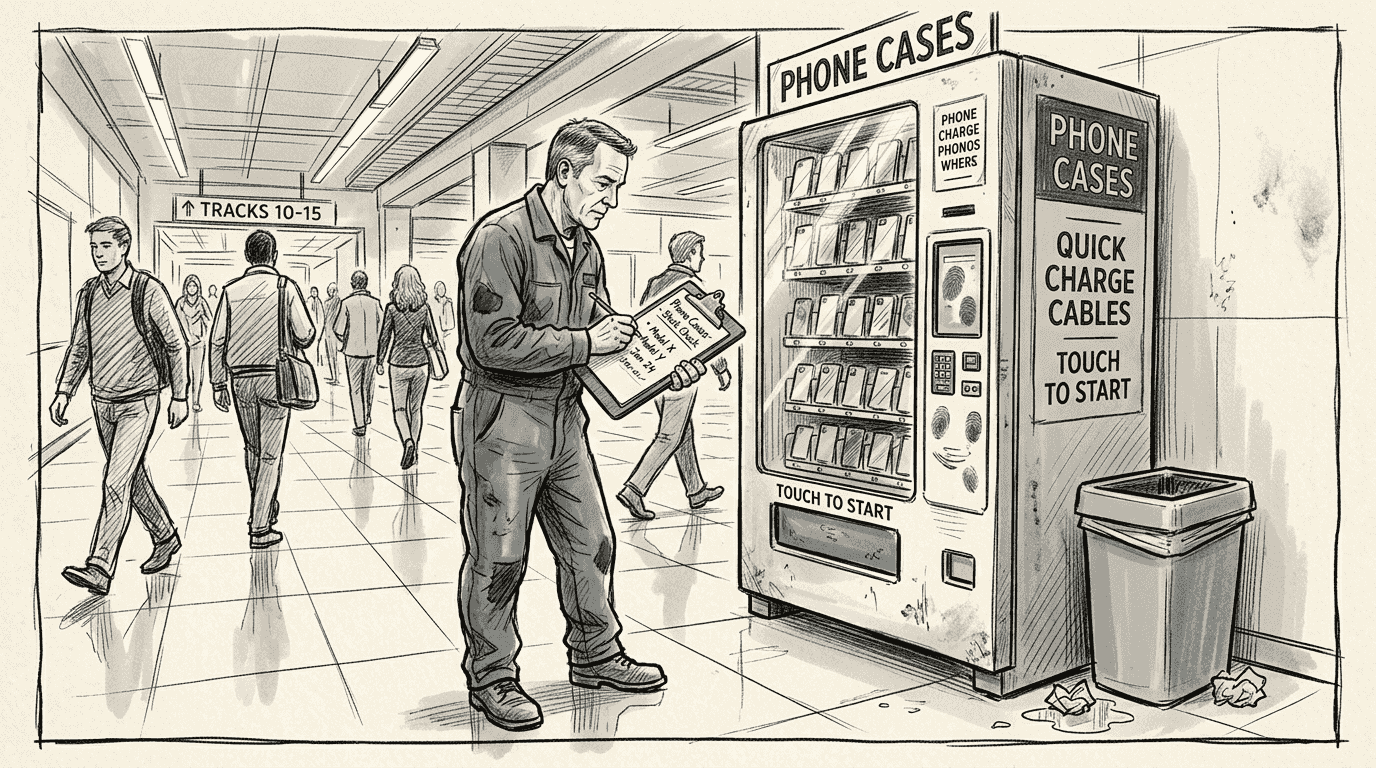
Vending machines represent the highest margin opportunity but require significant upfront capital for machine purchases and location agreements. Once operational, vending units incur minimal ongoing costs beyond restocking and occasional maintenance, allowing margins to exceed 80% on each sale. A well-placed vending machine can generate $800 to $2,000 monthly in net profit with little active management, making it an attractive passive income stream for entrepreneurs willing to invest $3,000 to $5,000 per unit initially.
Physical stores face the most challenging cost structure due to fixed monthly expenses that persist regardless of sales volume. Rent, utilities, insurance, and payroll create a high breakeven threshold that new stores struggle to surpass in their early months. Initial margins may dip below 20% as you absorb these overhead costs, though mature stores with strong foot traffic and optimized inventory can eventually achieve 40% to 50% net margins. The key difference is that physical stores must generate substantially higher revenues to deliver comparable take-home income versus online models.
Pricing strategies must account for these cost differences while remaining competitive in your market. Online sellers can afford lower prices due to reduced overhead, but undercutting too aggressively erodes your margin cushion and leaves no room for advertising investment. Physical stores need higher price points to cover fixed costs, which requires delivering superior customer experience or exclusive designs that justify the premium.
Pro Tip: Calculate your true cost per sale by including all fees, shipping, returns, and a portion of your ad spend, then work backward from your desired net margin to set minimum viable prices that sustain profitability.
Understanding these margin dynamics helps you choose the business model that aligns with your capital availability, risk tolerance, and income goals while avoiding the trap of chasing revenue without protecting profit.
Effective strategies to boost income in your phone case business
Increasing your phone case shop income requires deliberate strategies that expand your customer base, improve conversion rates, and raise average order values. Niche targeting stands as one of the most powerful approaches because it reduces direct competition and attracts buyers willing to pay premium prices for designs that resonate with their specific interests. Instead of competing in the saturated generic phone case market, focus on underserved niches like vintage car enthusiasts, specific dog breeds, or niche hobbies that have passionate followings but limited product options.
Etsy advertising and SEO optimization dramatically improve shop visibility and drive qualified traffic to your listings. Data shows that Etsy Ads can drive 103% revenue growth, AI design tools enable scaling listings to $5,000 to $10,000 monthly, and vending machines yield $800 to $2,000 monthly net profit. Investing 10% to 15% of revenue into Etsy Ads while optimizing your titles, tags, and descriptions for search creates a compounding effect where increased visibility leads to more sales, better search rankings, and further visibility gains.
AI-generated designs offer a scalable path to rapidly expand your product catalog without hiring designers or spending hours on manual creation. Tools like Midjourney or DALL-E let you produce hundreds of unique designs weekly, testing different styles and themes to identify what resonates with buyers. This volume approach increases the odds of creating viral designs while giving customers more reasons to return to your shop for fresh options. Sellers who leverage AI design tools often see faster growth trajectories than those relying solely on manual design work.
Proven income-boosting tactics include:
- Bundle multiple cases at a discounted rate to increase average order value
- Offer personalization options that command 20% to 40% price premiums
- Create matching accessory sets like case plus pop socket or screen protector
- Implement email marketing to drive repeat purchases from existing customers
- Use retargeting ads to recapture visitors who browsed but didn’t buy
- Deploy phone case marketing tips like seasonal promotions and limited edition drops
Vending machines provide an alternative income stream with minimal ongoing effort once installed. Placing units in high-traffic locations like malls, airports, or college campuses generates consistent passive revenue with margins exceeding traditional retail. The key is securing prime locations and maintaining adequate inventory levels to avoid stockouts during peak periods.
Pro Tip: Test new phone case design tips with small batches before committing to large inventory orders, using pre-orders or limited runs to validate demand and minimize risk.
Combining multiple strategies creates synergistic effects where improved designs attract more traffic, better marketing converts that traffic more efficiently, and upsells maximize revenue from each customer interaction. Successful sellers rarely rely on a single tactic, instead building integrated systems that drive sustainable income growth. Learning from ecommerce success strategies used by established brands can accelerate your own shop’s development and help you avoid common pitfalls.
Physical store vs. online phone case shop: comparing income potential
Physical stores and online shops represent fundamentally different business models with distinct income trajectories, risk profiles, and capital requirements. Physical locations demand substantial upfront investment, with physical stores projecting year one losses but scaling to $500,000+ EBITDA by year five with $600,000+ startup capital and 28-month breakeven periods. This financial modeling reveals the patience and deep pockets required to succeed in brick-and-mortar retail, where fixed costs create ongoing cash burn until revenue reaches sustainable levels.
Online shops offer dramatically lower barriers to entry, with many sellers launching for under $500 using POD platforms that eliminate inventory risk. Monthly operating costs rarely exceed $200 to $300 for hosting, apps, and basic advertising, allowing profitability within the first few months if marketing execution is solid. This faster path to positive cash flow makes online models attractive for bootstrapped entrepreneurs or those testing the market before committing larger sums.
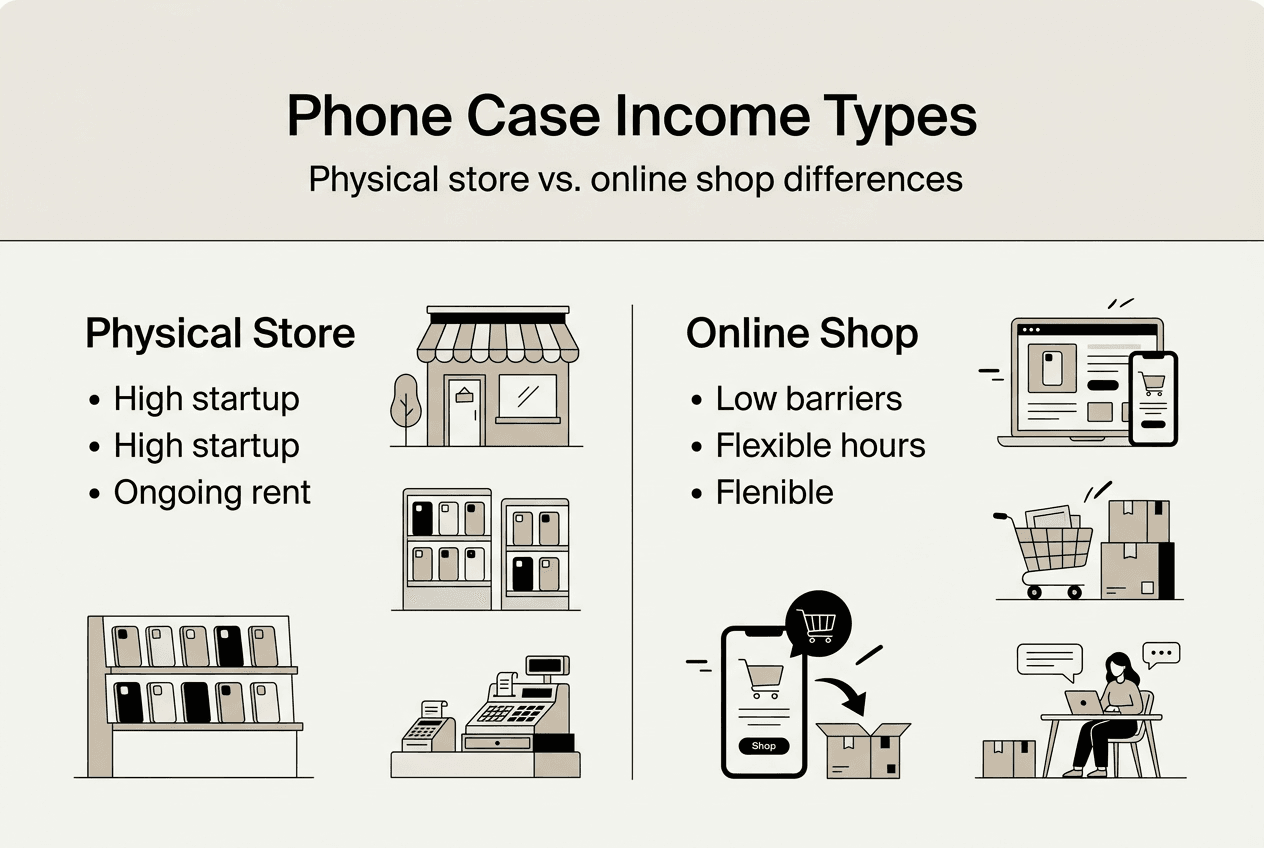
| Factor | Physical Store | Online Shop |
|---|---|---|
| Startup capital | $600,000+ | $500 to $5,000 |
| Monthly fixed costs | $15,000 to $30,000 | $200 to $1,000 |
| Breakeven timeline | 24 to 36 months | 3 to 6 months |
| Year one revenue potential | $200,000 to $400,000 | $6,000 to $120,000 |
| Five year profit potential | $500,000+ EBITDA | $60,000 to $300,000 net |
Risk tolerance plays a crucial role in model selection. Physical stores expose you to lease obligations, inventory obsolescence, and location-dependent performance that you cannot easily pivot away from if market conditions shift. Online shops let you test products, adjust pricing, and change niches with minimal switching costs, providing flexibility that reduces downside risk substantially.
Capital availability often makes the decision for you. Most entrepreneurs lack access to the $600,000+ required for a viable physical store launch, making online the only practical option. Those with significant capital must weigh whether the long-term profit potential of physical retail justifies the extended breakeven period and operational complexity versus deploying that same capital across multiple online ventures or other investment opportunities.
Combination strategies work for some entrepreneurs who start online to validate products and build brand awareness, then expand into physical retail once cash flow and customer base support the transition. This staged approach reduces initial risk while preserving the option to scale into higher-revenue physical channels as your business matures. Others operate hybrid models with a flagship physical location supported by robust online sales that provide geographic diversification and reduce dependence on foot traffic.
Key considerations when choosing between models:
- Your available startup capital and access to financing
- Risk tolerance for fixed obligations and longer payback periods
- Desire for passive income versus active retail management
- Local market dynamics and competition in your area
- Personal skills in online marketing versus retail operations
Understanding these tradeoffs helps you select the model that aligns with your financial situation, skills, and long-term vision for your phone case business. Neither path guarantees success, but matching your approach to your resources and capabilities dramatically improves your odds of building sustainable income. Exploring comprehensive guides on starting phone case business can provide additional clarity on which model suits your situation best.
Boost your phone case sales with Bettermockups tools
Professional product visuals separate successful phone case sellers from those struggling to gain traction in crowded marketplaces. High-quality mockups and video demonstrations build buyer confidence by showcasing your designs in realistic contexts that help customers envision the product in their hands. Bettermockups offers specialized phone case video mockups and static templates designed specifically for tech accessory sellers who need to create compelling listings quickly without expensive photography equipment or design skills.
Using professional mockups complements the income-boosting strategies covered earlier by improving conversion rates and allowing you to command premium prices. Buyers perceive products with polished visuals as higher quality and more trustworthy, directly impacting your sales velocity and average order value. The phone case mockup collection includes templates for iPhone, Samsung, and other popular models, ensuring your designs display beautifully across all major device categories. Getting started is straightforward with the detailed mockup usage guide that walks you through customization and export for various platforms.
How much can a beginner expect to earn from a phone case shop?
Beginners typically earn $500 to $2,500 monthly at side hustle scale, depending on effort invested in marketing and product development. Those who treat their shop as a serious business venture and implement effective strategies can reach the higher end of this range within three to six months. Scaling beyond $2,500 monthly requires more sophisticated approaches including paid advertising, expanded product catalogs, and systematic conversion optimization.
What are the best strategies to increase profit margins in a phone case business?
Focusing on niche designs reduces competition and allows premium pricing that improves margins significantly. Bundling products, offering personalization upsells, and using vending machines for passive income all boost profitability beyond basic POD models. Effective marketing tips for higher sales like Etsy Ads and SEO optimization increase revenue without proportionally raising costs, expanding your margin cushion.
Is starting a physical phone case store worth the investment in 2026?
Physical stores have high upfront costs and risk but can scale to strong six-figure profits long term if you have adequate capital and patience. They require $600,000+ in startup funding and typically take 24 to 36 months to break even, making them unsuitable for most entrepreneurs. Online shops offer faster returns with far less risk, though physical retail remains viable for well-capitalized operators in high-traffic locations. Comprehensive resources on starting phone case business can help you evaluate which path aligns with your financial situation.
How do vending machines compare to online shops for phone case income?
Vending machines generate $800 to $2,000 monthly net profit per unit with minimal ongoing effort once installed, offering true passive income. They require $3,000 to $5,000 upfront per machine and depend heavily on securing prime high-traffic locations. Online shops demand more active management but scale more easily across geographic markets without physical presence limitations, making them complementary rather than competing approaches for diversified income streams.


